 |
 |
 |
 |
|
|
|
|
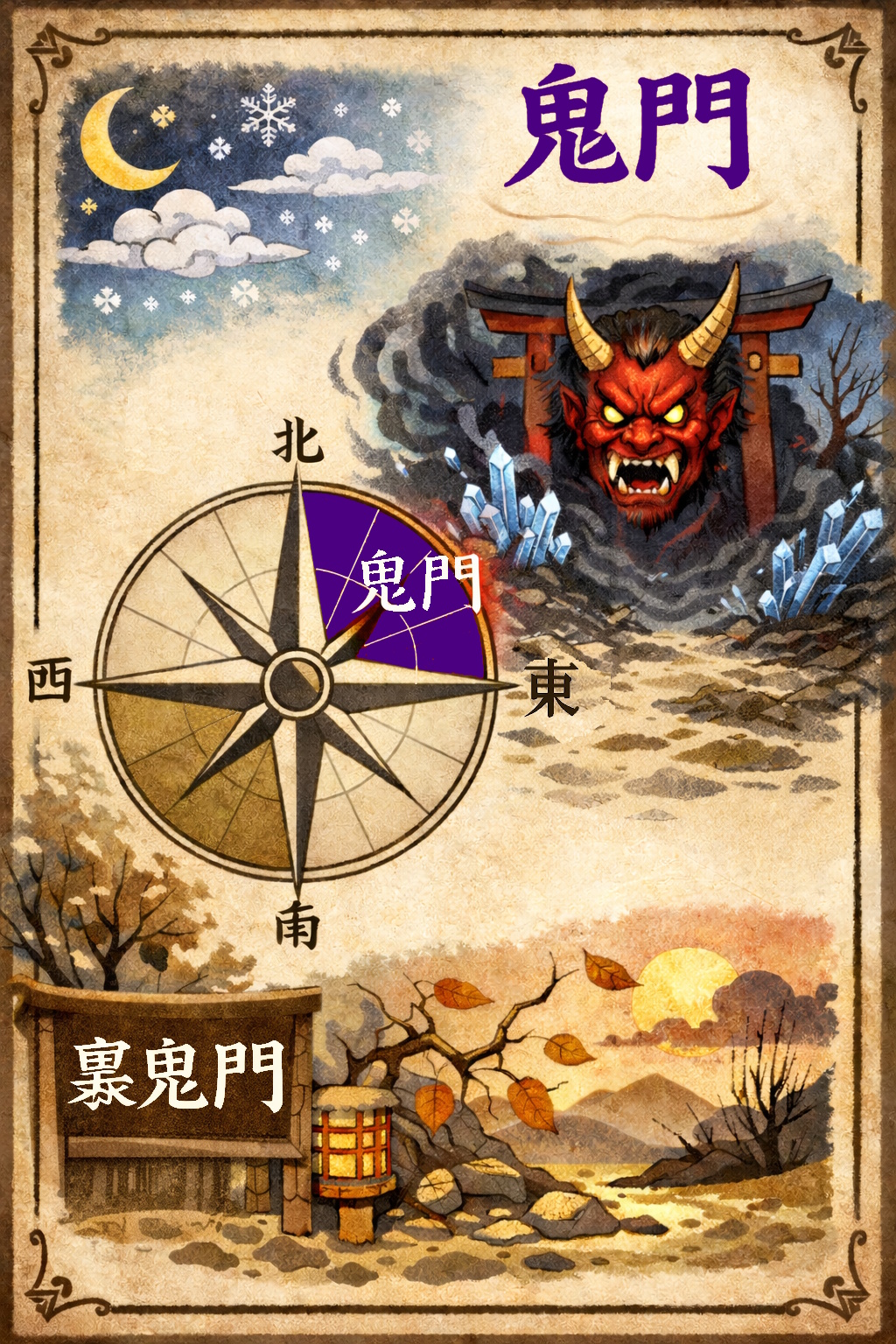
鬼 (ki) in this context means a demon, often shown as a horned ogre in Japanese folklore, and 門 (mon) means a gateway. Combining 鬼 and 門, despite the scary-looking demon in this picture, kimon isn't the name of a demon.
The use of 鬼 in 鬼門 is symbolic: It doesn’t literally mean a demon is expected to appear; rather it represents misfortune, disorder and/or harmful influences entering from that direction.
The other kanji characters in the picture are:
These compass points show that the direction of kimon is northeast - the direction to be most wary of. It is considered an inauspicious or vulnerable direction in Onmyōdō. It is not just northeast in a vague sense; it is treated as a specific angular sector.
You'll also notice in the bottom-left of the picture is 裏鬼門 (ura-kimon), which is sometimes treated as a secondary vulnerable point in the southwest. The kanji characters are 裏 (back, reverse, hidden side), 鬼 (demon), 門 (gate).
One nuance worth noting is that historically, kimon wasn’t just a superstition; it formed part of a structured system in Onmyōdō where directions, elements, seasons and energies were all linked.
For example, in the Japanese zodiac, the northeast is associated with the transition between the horned cow and the sharp-toothed tiger.
The sun and moon in the picture encode the cosmological background behind kimon. The night-day cycle relates to the yin–yang balance, opposing forces that must remain in equilibrium.
The northeast is not just a compass point; it’s a transition zone between north (yin) and east (yang), between night and day, between winter and spring. That shift is why kimon is seen as an open gateway where things can flow through.
You may see kimon used in contexts such as:
In all probability, kimon is not taken seriously "in real life" by most Japanese people today.
Where direction has clear scriptural grounding in Abrahamic traditions, kimon derives from a mix of imported cosmology, and later Japanese religious practice, formalised through court specialists and ritual systems associated with Onmyōdō.
The kimon direction is tied to cosmic balance, not moral good or evil. Shinto absorbed directional taboos into shrine placement and purification practices; for example; Enryaku-ji lies to the northeast of Kyoto as a protective site. Esoteric forms of Buddhism also incorporated protective rituals and guardian deities associated with directions.
So kimon has been institutionalised for over a millennium. However, unlike the Abrahamic Scripture, there's no single authoritative text stating “the northeast is the demon gate”. This is because kimon arises from cosmology and divination systems rather than divine revelation. Its authority is traditional and practical, not canonical.
Why should kimon have any interest for lavatorial enthusiasts?
Whether a toilet is placed northeast or anywhere else, it's smelly, dirty, associated with disease, and sometimes even spirits.
In Japanese folklore there's a toilet-related spirit called Akaname (垢嘗め, literally “filth-licker”). It’s a small goblin-like yōkai said to creep into dirty bathrooms at night. True to its name, it licks grime, mould and waste from neglected toilets and bath areas. It’s not usually portrayed as dangerous; rather it serves as a grotesque warning to keep things clean, otherwise something unpleasant may appear.
Hence the perceived alignment with kimon as a point of inflow risk. There is also reinforcement from Feng Shui: toilets are seen as places where qi (energy) drains away and the northeast is treated as a sensitive transitional sector. Therefore, where feasible, toilets in Japanese homes and buildings have traditionally been avoided in that direction.
That said, in practice, these days toilets are usually located according to convenience and the practicalities of plumbing and cost.
There's a thing called "post-hoc rationalisation". People remember something bad happened after we moved into a kimon house, and they forget all the times nothing happened. This is classic confirmation bias.
Japanese houses and apartments with toilets or front doors facing northeast function perfectly normally. There's no measurable difference in health, resale value or occupant outcomes.
If kimon were real, we should observe statistically higher illness or misfortune in NE-facing toilets or front doors, but no such evidence exists. Therefore it behaves like a cultural belief, not a measurable phenomenon.
門 is a gateway, not a closed barrier to prevent ingress.
We can see the difference in the kanji: 門 (mon) means gateway, 関 (seki) means barrier.
Moon -> yin
darkness, passivity, hidden forces
Sun -> yang
light, activity, life
Qur'an 2:144, 2:149–150, 3:96
Old Testament 1 Kings 8:29–30, Daniel 6:10
New Testament Matthew 24:27